

January 30 – 11 February 2027
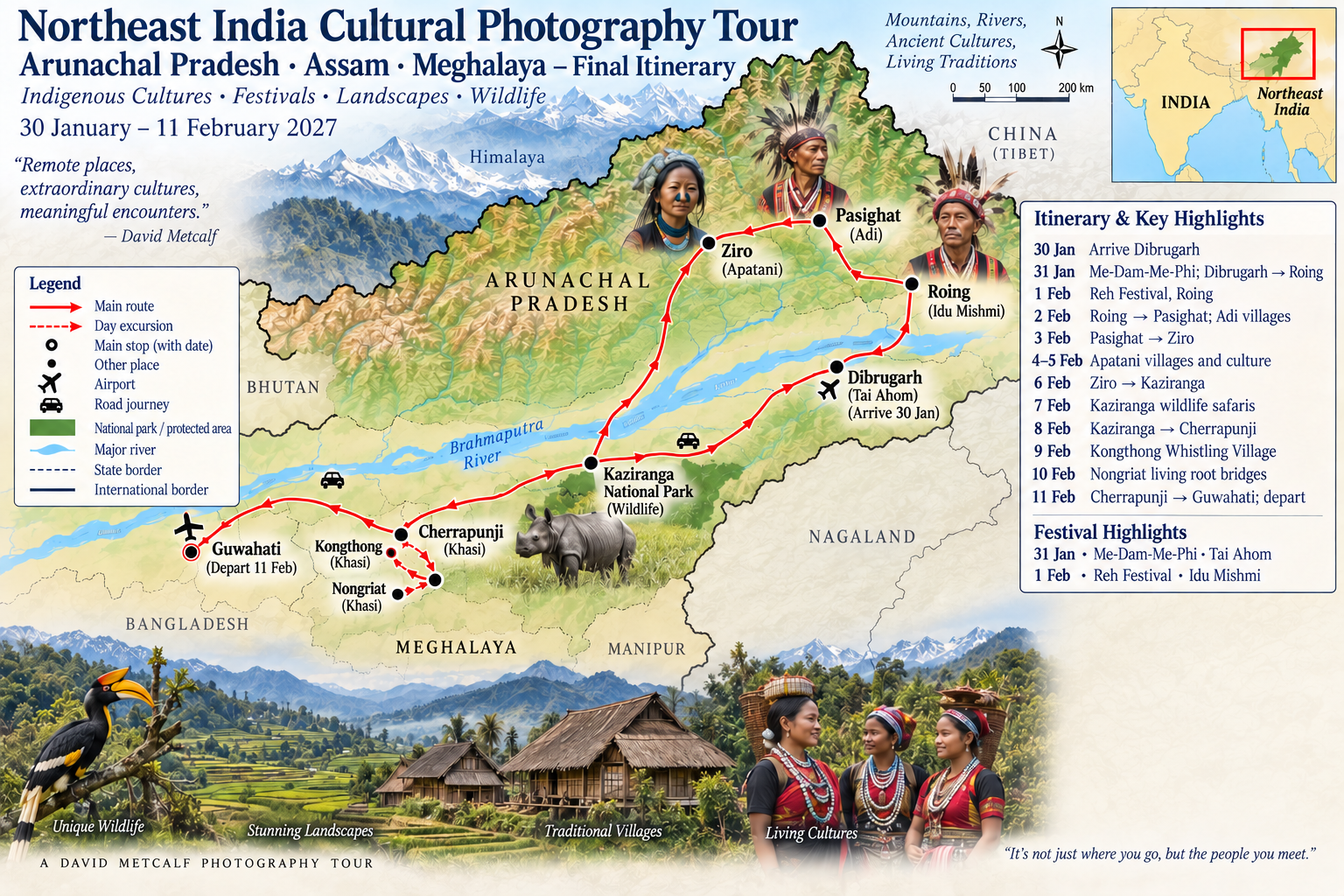
Join me for an extraordinary cultural photography journey through Assam, Arunachal Pradesh and Meghalaya in Northeast India.
Across India’s far northeastern frontier lies a world shaped by great rivers, forested mountains, ancient rituals and resilient Indigenous communities whose heritage has endured for centuries. This journey is an immersion into living culture, an encounter with Indigenous knowledge and an invitation to slow down and witness traditions that continue to shape everyday life.


Our journey begins in Dibrugarh, where we experience Me-Dam-Me-Phi, the important ancestral festival of the Tai Ahom people. Celebrated each year on January 31, the festival honours departed ancestors through prayers, ceremonial offerings, traditional dress, music and community gatherings. It provides our first insight into the deep relationship between ancestry, identity and spiritual life in Northeast India.
From Dibrugarh, we travel into Arunachal Pradesh and the foothills of the Mishmi Hills. In Roing, we attend Reh, the most important annual festival of the Idu Mishmi people. The celebrations bring families and communities together through sacred rituals, chanting, dance, music and feasting. Reh also offers a rare opportunity to learn about the role of the Igu, the Idu Mishmi shaman and keeper of ritual knowledge, oral history and spiritual traditions.
Travelling onward to Pasighat, we enter the heartland of the Adi people. The powerful Siang River flows through this region, shaping its landscapes, agriculture and village life. We visit Adi communities, walk to a more remote village and spend time learning about traditional homes, bamboo craftsmanship, oral traditions and the close relationship between the Adi people and their natural environment.
The landscape changes again as we travel west to the beautiful Ziro Valley, homeland of the Apatani people. Traditional villages such as Hong, Hari and Dutta are known for their closely built wooden and bamboo houses, narrow lanes and strong sense of community. We hope to meet some of the remaining tattooed elders, whose facial tattoos and distinctive nose plugs represent customs that are no longer practised by younger generations.
The Apatani are also recognised for their sophisticated system of wet-rice cultivation and fish farming. Carefully managed irrigation channels distribute water through the valley’s terraced fields, reflecting generations of accumulated environmental knowledge. During our two days in Ziro, we explore the villages, farms and local market, experience traditional food and, where possible, meet an Apatani shaman.
Leaving the mountains, we travel to Kaziranga National Park, one of India’s greatest wildlife reserves. Morning and afternoon jeep safaris take us through grasslands, wetlands and forest in search of greater one-horned rhinoceroses, wild elephants, Asian water buffalo, swamp deer and abundant birdlife. An early-morning elephant safari provides another perspective on the park and its wildlife.
Our final destination is the Khasi Hills of Meghalaya. From our base in Cherrapunji, traditionally known as Sohra, we visit Kongthong, the remarkable Whistling Village. Here, every person receives a unique melody composed by their mother after birth. Known as Jingrwai Iawbei, this living tradition expresses the bond between mother and child, connection to the maternal clan and the Khasi people’s relationship with the natural world.
We also hike to the village of Nongriat, home to Meghalaya’s extraordinary living root bridges. These structures are grown by carefully guiding the aerial roots of rubber fig trees across rivers and ravines. Strengthened and maintained over generations, they demonstrate how Khasi knowledge and ingenuity work in harmony with the surrounding forest.
Throughout the journey, the emphasis is on connection: sitting with families, learning from elders, observing ceremonies and photographing daily life with care and respect. It is a profoundly human experience guided by curiosity, humility and a desire to understand the people and stories that define Northeast India.
Experience Me-Dam-Me-Phi in Dibrugarh, an important festival honouring the ancestors of Assam’s Tai Ahom community. Witness traditional prayers, ceremonial offerings, cultural performances and community gatherings.
Attend the most important annual festival of the Idu Mishmi people in Roing. Experience ritual chanting, traditional dancing, distinctive textiles, ceremonial dress and the spiritual traditions preserved by Idu Mishmi shamans.
Explore Pasighat and nearby Adi villages along the Siang River. Photograph traditional homes, bamboo craftsmanship, village life and the dramatic landscapes of one of Arunachal Pradesh’s most culturally significant regions.
Spend two full days exploring Apatani villages, meeting tattooed elders and learning about traditional architecture, weaving, food and village customs. Discover the Apatani people’s remarkable rice-and-fish farming system and environmental knowledge.
Enjoy morning and afternoon jeep safaris through one of India’s most successful conservation areas. Kaziranga protects the world’s largest population of greater one-horned rhinoceroses as well as wild elephants, Asian water buffalo, swamp deer and diverse birdlife.
Visit a Khasi community where every resident receives a unique melody composed by their mother. Learn about Jingrwai Iawbei and the connection between this remarkable tradition, maternal ancestry and the surrounding landscape.
Hike through the forests of the Khasi Hills to Nongriat and its famous double-decker living root bridge. Along the way, cross streams, waterfalls, traditional suspension bridges and approximately 3,000 stone steps.
Photograph two important festivals, four distinctive Indigenous communities, remote villages, traditional agriculture, wildlife and the dramatic landscapes of Assam, Arunachal Pradesh and Meghalaya.
This cultural photography journey offers an exceptional diversity of subjects, environments and storytelling possibilities. Each destination presents a distinct visual identity, from colourful festivals and intimate village life to mountain landscapes, wildlife and living traditions.
Me-Dam-Me-Phi provides opportunities to document ceremonial offerings, traditional clothing, music, dance and community participation. The emphasis will be on observing respectfully and understanding the meaning of the festival before photographing its ceremonies and participants.
Portraits, wider scenes and details of clothing and ritual objects can be combined to create a complete visual story of the festival and its importance to the Tai Ahom people.
Reh offers some of the journey’s most important cultural photography. Traditional Idu Mishmi clothing, handwoven textiles, ritual chanting, dance, food preparation and family gatherings provide a rich range of subjects.
Portraits can be created using natural light around homes and festival grounds, while wider compositions can show the relationship between participants, ceremonies and the surrounding Mishmi Hills. Photography during sacred rituals will always be approached carefully and with permission.
The Pasighat region combines dramatic riverscapes with village and cultural photography. The Siang River provides a powerful visual backdrop, while Adi villages offer opportunities to photograph traditional houses, bamboo craftsmanship, agricultural life and daily community activities.
Walking to a more remote village allows time to observe the changing landscape and create environmental portraits that place people within the places where they live and work.
Ziro is the cultural heart of the journey. The compact Apatani villages provide strong opportunities for environmental portraiture, particularly among elders with traditional facial tattoos and nose plugs.
Wooden houses, narrow village lanes, hearths, weaving, food preparation and everyday activities create natural settings for documentary photography. The terraced rice fields and intricate irrigation systems also produce striking patterns and layered landscape compositions.
Our time in Ziro allows us to work slowly, build trust and develop more meaningful photographic stories rather than simply collecting individual images.
Wildlife photography becomes the focus in Kaziranga. Early-morning and afternoon light can create atmospheric conditions across the park’s grasslands and wetlands.
The greater one-horned rhinoceros is the principal subject, but we may also photograph wild elephants, Asian water buffalo, swamp deer, wild boar and a wide variety of birds. Telephoto lenses will be particularly useful for wildlife behaviour and more distant sightings, while wider lenses can place animals within Kaziranga’s distinctive landscape.
The Khasi Hills offer a combination of landscape, village and cultural photography. Kongthong provides opportunities to document village life and learn about the personal melodies that form part of each resident’s identity.
The forest trail to Nongriat offers strong leading lines, natural textures and layered compositions. The living root bridges are particularly suited to wide-angle photography, while streams, forest paths and waterfalls provide opportunities to experiment with slower shutter speeds.
Environmental portraits of Khasi villagers can place people within the homes, pathways and forests that shape their daily lives. The soft and often filtered light of the Khasi Hills is especially suitable for natural portraiture.
Throughout the journey, our purpose extends beyond making beautiful photographs. We take time to build trust, understand what we are witnessing and engage thoughtfully with the people we meet. The aim is to create meaningful photographic narratives that honour the communities, traditions and landscapes of Northeast India.
For pricing and additional details, please contact David directly on WhatsApp at +628111331255 or via email at davidmetcalf312@gmail.com.
All Meals
13 Nights accommodation
Native English speaking professional tour guide
Entrance fees to temples and parks


© Copyright 2025 | David Metcalf Photography – PT Damee International | All rights reserved